


A cracked silver filling can leave a rough spot on your back tooth, cause sensitivity when you bite, or make the tooth feel different than usual.
These changes are worth checking, especially if you notice pain, a loose filling, or a new gap around its edges.
Old silver fillings can last a long time, but they do not last forever, and when one starts to crack or leak, your tooth is telling you something.
A silver (amalgam) filling that is leaking means its seal against the tooth has broken down, letting bacteria and moisture sneak underneath.
That does not always mean the tooth is in trouble right now, but it does mean it is worth a closer look. The real question is not how old the filling is. It is whether it is still doing its job.
At Premier Dental Associates, this comes up often with patients who have had the same fillings since childhood or their twenties.
Age alone rarely decides whether a filling needs to come out. What matters is what the dentist finds underneath.
Key Takeaways
- Sensitivity, pain when chewing, or a rough edge matter more than a filling’s age alone.
- A dental exam and x-rays can find hidden decay or cracks that you cannot see or feel.
- Replacement options range from a simple composite filling to an inlay, onlay, or crown, depending on how much healthy tooth remains.
Table of Content
- What Are the Signs of a Cracked or Leaking Filling?
- When Should a Silver Filling Be Replaced?
- How Does a Dentist Check the Filling and Tooth?
- Which Tooth-Colored Repair Is Right for the Tooth?
- What Should You Expect From Replacement?
- Replace a Failing Filling, Not Just an Old One
- Frequently Asked Questions
What Are the Signs of a Cracked or Leaking Filling?
Most failing fillings give you a warning before anything serious happens. You might notice new sensitivity to cold or sweets, a sharp catch when you bite down, or a tooth that just feels different than it used to.

Changes You Can See or Feel Around the Filling
A rough or sharp edge is often the first clue, something your tongue notices before your eyes do. You might also see a visible crack, a chip, or a dark line tracing the border where the filling meets your tooth.
Food getting stuck in the same spot meal after meal is another signal worth mentioning to your dentist. So is a filling that feels like it has shifted slightly, or a faint metallic taste that was not there before.
None of these signs confirm decay on their own. A dark line at the edge of an old filling can be stable staining rather than an active problem, which is one reason a visual check at home only tells part of the story.
When Does Pain or a Lost Filling Need Prompt Attention?
Pain when chewing or a filling that feels loose deserves a call to your dentist soon, not a wait-and-see approach.
Sharp pain on biting can mean the filling has cracked, the tooth around it is fracturing, or decay has crept in underneath.
A filling that has fallen out completely needs attention within days, since the exposed tooth has no protection from bacteria or temperature changes.
In the meantime, avoid chewing on that side and steer clear of very hot, cold, or sugary foods.
A tiny rough spot with no pain can usually wait until your next checkup. Ongoing sensitivity, a visible gap, or a piece that broke off should not wait that long.
When Should a Silver Filling Be Replaced?
A silver amalgam filling may need replacement if new decay, a crack, an open margin, or other damage affects the tooth.
When enough healthy tooth structure remains, tooth-colored fillings can provide a natural-looking way to restore the damaged area.
Dentists call new decay under or beside an old filling “recurrent decay” or “secondary decay,” and it is one of the most common reasons an otherwise sound-looking filling needs to come out.
Damage, Open Edges, and Decay Around the Filling
An open margin happens when the filling starts pulling away from the tooth, leaving a tiny gap at the edge. That gap becomes an easy path for bacteria, and decay can set in before you feel anything at all.
Cracks in the filling material itself are common after years of chewing forces and temperature changes, and they create the same kind of opening for bacteria.
Sometimes the filling stays intact while the surrounding tooth structure develops its own crack, especially with larger fillings that act almost like a wedge inside the tooth.
In some cases the filling is fine but the tooth around it has broken, which still means the old filling has to be removed to repair the tooth properly.
When Is Monitoring Better Than Replacement?
An intact, well-sealed filling with no pain or visible damage usually does not need to be replaced right away.
Many amalgam fillings last well beyond a decade, and some last considerably longer with good home care and regular checkups
If your dentist sees early wear with no decay, watching it at future visits is often a reasonable plan. Replacing a filling that is working fine adds cost and removes healthy tooth structure for no real benefit.



How Does a Dentist Check the Filling and Tooth?
A comprehensive dental exam can help your dentist assess a damaged filling, check for decay, and determine whether X-rays or additional testing are needed.
What you notice at home (a rough edge, occasional sensitivity) gives your dentist a starting point, but it cannot show what is happening beneath the surface.
What Can an Exam and X-Rays Reveal?
During an exam, your dentist checks the margins of the filling with a small instrument, feeling for gaps or softness that suggest decay.
A dental x-ray can show decay hiding between teeth or underneath a filling long before it causes pain, along with any shadows that hint at a breakdown in the seal.
X-rays also show bone levels and any changes near the root, which matters if a crack has been irritating the nerve for a while. Without imaging, a lot of early decay simply stays invisible.
Why Do Cracks and Remaining Tooth Structure Matter?
The amount of healthy tooth left after removing the old filling and any decay drives the whole treatment decision. A tooth with plenty of its own structure remaining can often support a straightforward filling.
A tooth that has lost a lot of structure, whether from the original cavity, a large old filling, or a new crack, may need something sturdier to avoid breaking under normal chewing pressure.
Your dentist is checking not just for decay, but for how much natural tooth is left to build on.
Which Tooth-Colored Repair Is Right for the Tooth?
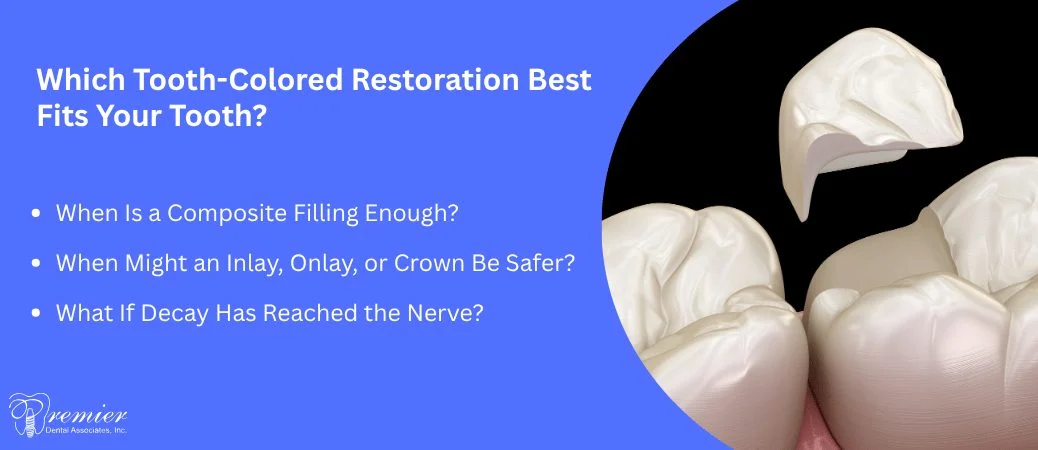
A composite (tooth-colored) filling works well for small to moderate cavities or cracks with plenty of healthy tooth remaining, while larger areas of damage usually call for an inlay, onlay, or crown.
The right choice comes down to how much of the tooth’s original structure is left to work with, not personal preference about appearance alone
When Is a Composite Filling Enough?
A composite filling is the simplest option when the area of decay or damage is small and there is a solid base of healthy tooth around it.
These tooth-colored composite fillings bond directly to the tooth and can usually be placed in a single visit.
They work well for replacing a small cracked or leaking section of an old silver filling, especially on teeth that do not take heavy biting force.
When Might an Inlay, Onlay, or Crown Be Safer?
Inlays and onlays can restore larger areas of damage when a regular filling may not provide enough support.
These custom restorations help preserve remaining healthy tooth structure when full crown coverage is unnecessary.
A dental crown may be recommended when extensive decay or a fracture has weakened the remaining tooth.
Depending on the case, CEREC one-day crowns can provide a custom restoration without the usual wait for a laboratory-made crown.
A crown covers the entire visible part of the tooth down to the gumline, which helps hold the remaining structure together under pressure.
If the tooth itself is fractured, our guide to a cracked tooth emergency explains which symptoms may require prompt dental attention.
What If Decay Has Reached the Nerve?
A root canal becomes necessary when decay or a crack has reached the pulp, the soft tissue inside the tooth that contains nerves and blood vessels.
Once that tissue is infected or inflamed beyond recovery, a root canal removes the affected tissue so the tooth can be saved and restored, usually with a crown afterward.
This is one of the reasons dentists do not wait on a cracked or leaking filling that is already causing pain.
Restorative dentistry has several tools for saving a tooth, but each step up (filling, onlay, crown, root canal) usually means more time and expense than catching the problem earlier would have.
What Should You Expect From Replacement?
Replacing an old filling is a routine procedure done under local anesthetic, similar to getting a new filling placed for the first time. Most people describe it as no more uncomfortable than their original filling appointment.
Removing the Old Filling and Restoring the Tooth
Your dentist removes the old dental amalgam, along with any decay found underneath, then prepares the tooth for its new restoration. A straightforward composite filling usually takes one visit.
An inlay, onlay, or crown typically takes two visits, since the permanent restoration is custom-made while a temporary covering protects the tooth in between.
Sensitivity and Care After Treatment
Mild sensitivity to hot, cold, or pressure for one to two weeks afterward is normal and expected. The nerve inside the tooth reacts to the drilling, even when everything goes smoothly, and this usually settles on its own.
If discomfort lasts longer than two weeks or gets worse instead of better, call your dentist.
Some patients consider replacing silver fillings for cosmetic reasons. However, removing an intact filling can also remove healthy tooth structure, so the benefits and risks should be discussed before treatment.
Replace a Failing Filling, Not Just an Old One

An old silver filling is not automatically a problem. Plenty of amalgam fillings sit quietly in people’s mouths for twenty years or more without causing any trouble.
What matters is whether the filling and the tooth around it are still doing their job.
Cracks, open margins, new sensitivity, and pain on biting are the signals worth acting on, not the color of the material or the number of years it has been in your mouth.
If something feels off with an old filling, a short visit to Premier Dental Associates for an exam and x-ray will tell you far more than guessing at home ever could.
Catching a problem early almost always means a simpler, smaller fix.
Frequently Asked Questions
Can a silver filling leak without causing pain?
Yes. A leaking filling can let bacteria in long before any pain develops, since early decay often grows quietly in the softer layer of the tooth beneath the enamel.
This is why regular checkups and x-rays matter, even for fillings that feel completely fine.
Does a dark line around my filling mean it has cracked?
Not always. A dark line can be old staining that has been stable for years, or it can signal a gap where decay is starting underneath.
Your dentist can tell the difference by checking the margin with an instrument and reviewing an x-ray if needed.
Should I remove an intact silver filling because it contains mercury?
The FDA does not recommend removing or replacing amalgam fillings that are in good condition solely because of the mercury they contain.
Removing a sound filling means drilling out healthy tooth structure along with it, which carries its own risks.
Can every large silver filling be replaced with a white filling?
Not every tooth is a good candidate for a plain composite filling, especially if a lot of the natural tooth has already been lost.
In those cases, an inlay, onlay, or crown often provides sturdier, longer-lasting support than a filling alone would.
How soon should I see a dentist if my silver filling falls out?
Book an appointment within a few days, since the exposed tooth has no protection from bacteria or temperature sensitivity in the meantime.
Avoid chewing on that side, rinse gently with warm salt water, and skip very hot, cold, or sugary foods until you are seen.