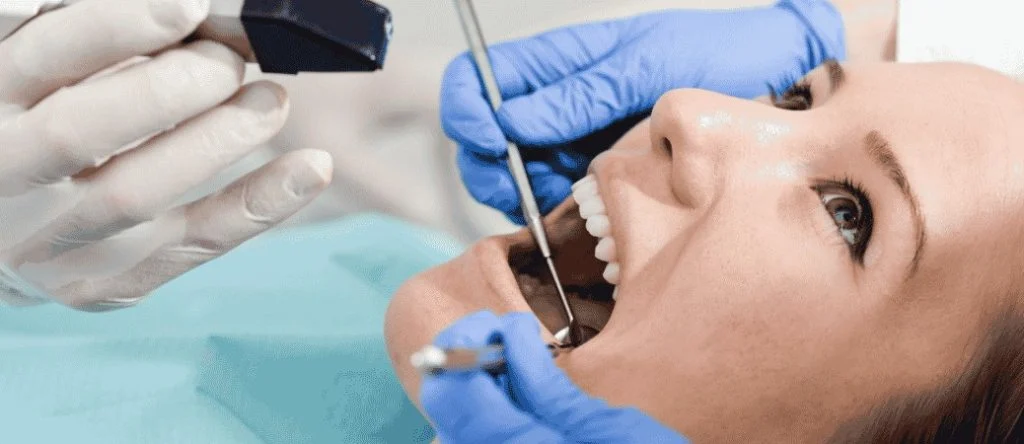

You walk in with a cracked or heavily filled tooth. You walk out with a finished ceramic crown bonded in place. No goopy mold, no temporary crown, no second appointment two weeks later.
That is the promise of same-day crowns, and for most single-tooth cases it holds up. The catch is time.
Plan on roughly two hours in the chair for a CEREC crown appointment, since the tooth preparation, the digital scan, the design, and the milling all happen while you wait.
Some visits finish closer to 90 minutes; complicated teeth run longer.
The dental crown itself is the same kind of restoration your dentist has always placed. CEREC crowns change where the crown gets made, not what it does.
You still get a permanent crown that covers the whole tooth and takes the full force of chewing.
Knowing what to expect from the same-day dental crown procedure makes the visit far less stressful.
Eat beforehand, clear your calendar, bring something to keep you occupied, and ask a few specific questions before treatment starts.
Key Takeaways
- Block out about two hours, eat a real meal first, and bring headphones or a book for the milling wait.
- The numbing and tooth shaping feel exactly like any crown visit; the scan, design, and milling are what CEREC changes.
- Same-day works well for a single back tooth, while front teeth needing detailed shading are often better sent to a lab.
Table of Content
- How to Get Ready Before Your Appointment
- What Actually Happens During the Visit
- How Same-Day CEREC Crowns Compare With Traditional Crowns
- Who Is a Good Candidate and Which Material Is Used?
- Aftercare That Helps Your New Crown Last
- Prepared for One Visit, Restored for the Long Term
- Frequently Asked Questions
How to Get Ready Before Your Appointment
Good preparation for a same-day crown appointment comes down to four things: knowing what your dentist plans to do, arriving fed and comfortable, having a plan if the dental chair makes you tense, and confirming whether the tooth needs other treatment first.
A little of this ahead of time saves a lot of second-guessing once you are reclined with your mouth open.
What to Ask Your CEREC Dentist Before Treatment
Ask your CEREC dentist how long they expect your appointment to run. A single molar and a front tooth are different jobs, and the honest estimate helps you plan the rest of your day.
Other questions worth asking:
- Is my tooth a good candidate for same-day treatment, or would a lab crown fit better?
- Which material will you use, and why that one for this tooth?
- What happens if the fit or shade is not right when the crown comes out of the mill?
- What is my out-of-pocket cost after insurance?
Ask what happens after, too. Knowing which sensations are normal in the first week means you will not spend three days wondering whether to call.
What to Eat, Bring, and Plan for That Day
Eat a normal meal before you come in. You will be numb on one side for a few hours afterward, and chewing with a numb cheek is how people bite themselves.
Skip nothing else. Take your regular medications, and mention any of them at check-in if the office does not already have them on file. If you take something for anxiety, tell the team before treatment starts.
Bring headphones, a podcast, or a book. The milling stretch is quiet downtime where you are sitting in the chair with nothing to do for 10 to 20 minutes.
A few practical items:
- A lip balm (your lips get dry with your mouth open)
- Sunglasses if the overhead light bothers you
- A phone charger
- Your insurance card and any new patient registration paperwork you were asked to complete
Do not schedule a big presentation or a dinner out right after. Most people feel fine, but a numb lip is not a great look for either.
How to Prepare if You Have Dental Anxiety

Tell the office you have dental anxiety when you book, not when you sit down. Written on your chart, it changes how the whole team handles the visit.
Agree on a hand signal before treatment begins. Raising your left hand should stop everything, and knowing you have that control takes the edge off more than people expect.
Ask about scheduling a morning appointment, when you have had less time to build up dread. Ask about the topical gel that goes on before the local anesthetic injection, which dulls the pinch of the needle.
For strong anxiety, ask whether sedation dentistry is available. Nitrous oxide wears off within minutes, so you can still drive yourself home in most cases.
Bring someone with you if that helps. There is no rule against a friend in the waiting room, and it is not something to feel awkward about.
When a Root Canal or Other Treatment May Come First
If the tooth has a deep infection or the nerve is dying, a root canal has to happen before the crown goes on. Your dentist may do both in one longer visit, or split them across two.
Signs that point this direction include lingering pain to hot or cold, throbbing at night, swelling near the gum, or a tooth that hurts when you bite down.
Mention any of these when you book so the schedule allows enough time.
Gum problems can also delay things. If the gum around the tooth is inflamed or bleeding heavily, it is hard to capture a clean scan of the crown margin, and your dentist may want periodontal services first.
Sometimes the tooth needs a buildup, a small filling placed to rebuild enough structure to support a crown. That adds 15 minutes or so, and it happens right there in the same visit.
What Actually Happens During the Visit
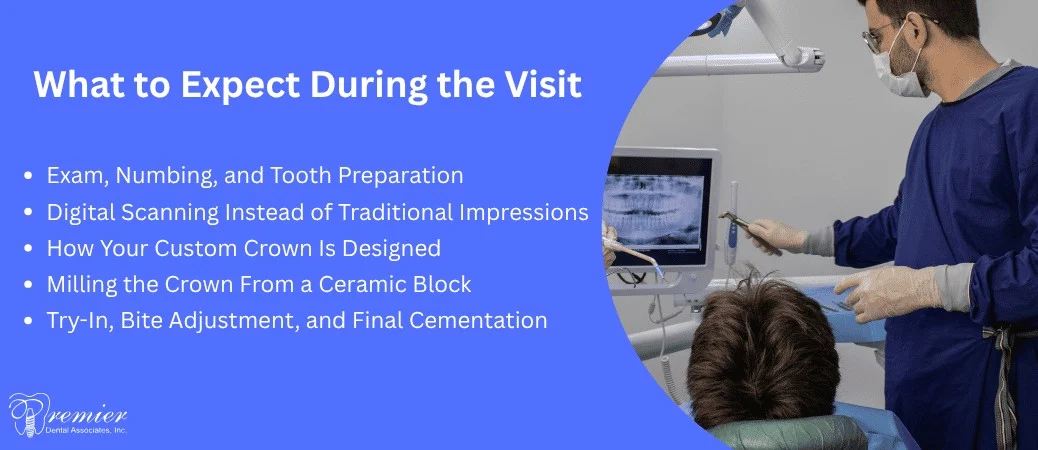
Half of a CEREC visit is identical to a traditional crown visit: exam, numbing, shaping the tooth.
The other half swaps the putty tray and the lab courier for a scanner wand and a milling unit humming in the corner while you wait.
Exam, Numbing, and Tooth Preparation
Your dentist starts by looking at the tooth and reviewing an X-ray to confirm a crown is the right call and that the root is healthy. This takes a few minutes.
Then comes numbing. A topical gel goes on the gum first, then the local anesthesia injection. Give it five to ten minutes to take full effect, and speak up if any part of the tooth still feels sharp.
Tooth preparation means reshaping the tooth so the crown has room to sit. Old filling material and decay come out, and the dentist trims the outside surfaces down to a smooth shape with a clean margin at the gum line.
You will feel pressure, water spray, and vibration. You should not feel pain. Crown preparation runs about 20 to 30 minutes for a straightforward tooth.
Digital Scanning Instead of Traditional Impressions
An intraoral scanner replaces the impression tray. It is a wand about the size of an electric toothbrush that your dentist moves slowly over the prepared tooth, the teeth around it, and the opposing arch.
Digital scanning takes two to four minutes and builds a 3D model on the screen next to you. Nothing sets in your mouth, and nothing triggers a gag reflex.
You will also be asked to bite down while the wand captures both arches together. That bite record tells the software how your teeth meet.
Most people prefer this step to the old method by a wide margin. Digital impressions also let the dentist zoom in and rescan a single area in seconds if a spot is unclear, which is not possible with putty.
How Your Custom Crown Is Designed
Computer-aided design software proposes a crown shape based on your scan and the teeth on either side. Your dentist then refines it on screen.
The CAD software adjustments cover contours, the contact points where the crown touches neighboring teeth, groove patterns on the chewing surface, and bite alignment.
This is where experience shows, since the software’s first suggestion is a starting point.
Crown design usually takes 5 to 15 minutes. Many dentists turn the monitor so you can see the design, and you are allowed to ask questions about it.
Chairside CAD/CAM technology means the person shaping your tooth is also shaping your crown, with your actual mouth two feet away.
That feedback loop is one of the practical advantages of CEREC one day crowns over sending a case out.
Milling the Crown From a Ceramic Block
The design goes to an in-office milling machine, which carves your crown out of a solid ceramic block using diamond burs and water.
The block is roughly the size of a sugar cube and comes in a range of shades matched to your teeth.
Milling takes about 10 to 20 minutes depending on the material and the crown’s complexity. You will hear a steady grinding noise from the milling unit.
This is your break. Get up, use the restroom, check your phone, walk outside. Nobody expects you to sit still in the chair.
Some materials go into a small furnace after milling for a crystallization or glazing step, which adds 10 to 20 minutes and gives the crown its final strength and gloss. Your dentist will tell you if that applies to your case.
Try-In, Bite Adjustment, and Final Cementation
Your dentist tries the crown in without cement first to check the marginal fit at the gum line, the contact with neighboring teeth, and the shade against your natural enamel.
Floss gets passed between the crown and its neighbors to confirm the contact is snug but not locked.
Then you bite on thin colored paper. The marks show high spots, and your dentist polishes those down until your bite feels even.
This bite adjustment step takes a few minutes and is worth being picky about, since a crown that sits even slightly high causes soreness for days.
Once the fit is right, the tooth is cleaned and dried, and the crown is bonded with dental adhesive or dental cement. Final cementation involves a curing light and takes about five minutes.
Your dentist cleans off excess cement, flosses one more time, and rechecks the bite. Crown placement is done, and the crown is permanent from that moment.



How Same-Day CEREC Crowns Compare With Traditional Crowns
CEREC stands for Chairside Economical Restoration of Esthetic Ceramics, and the core difference is where the crown gets built.
A traditional crown is made in a dental lab over one to three weeks; a CEREC same-day crown is milled in the office in under half an hour.
| Same-Day CEREC Crown | Traditional Lab-Made Crown | |
| Appointments | 1 | 2 |
| Chair time | About 2 hours | About 1 hour + 30 min |
| Temporary crown | No | Yes, 1 to 3 weeks |
| Impressions | Digital scan | Putty tray or digital |
| Material options | Ceramic blocks in stock | Full lab range, layered porcelain |
| Typical cost | $500 to $1,500 per tooth | $800 to $1,700+ per tooth |
Why You Can Skip the Temporary Crown
No temporary crown means no plastic cap held on with soft cement for two weeks. Temporaries are the source of most crown-related complaints between visits.
They come loose while you eat. They let cold air hit the prepared tooth. They can leak, and the gum around them gets irritated because the fit is approximate by design.
Skipping that phase also removes the risk of the prepared tooth shifting slightly if a temporary falls off and you cannot get in right away.
If you have dealt with a dental crown that keeps falling off, you know how disruptive that gap can be.
You leave with a bonded ceramic crown and chew on it that afternoon.
Benefits and Trade-Offs to Consider
The clearest benefit is one visit instead of two, plus one round of numbing instead of two. For anyone who takes time off work for dental appointments, that is a real saving.
Digital dentistry also removes the impression tray, which matters if you gag easily.
And preparing a tooth for a bonded ceramic crown can be more conservative, with reports of 15 to 20 percent more natural tooth structure preserved compared with some conventional preparations.
The trade-offs are honest ones:
- You sit longer in one stretch. Two hours in a chair is harder for some patients than two shorter visits.
- Material choice is narrower. The office stocks specific ceramic blocks, so exotic layered porcelain is not on the menu.
- Shade matching is done chairside. Milled crowns come in one solid color and are stained and glazed to match, which works beautifully on molars and is more demanding on front teeth.
- Not every office has the equipment, and results depend on the dentist’s experience with the system.
When a Traditional Lab-Made Crown May Be Better
A front tooth next to natural enamel is the strongest case for sending the work to a lab.
A skilled ceramist can hand-layer porcelain to copy the subtle translucency at the edge of a natural incisor, and that level of detail is hard to reproduce chairside.
Lab-made crowns also make sense when you are having several teeth done together, when a bridge is involved, or when the case includes veneers that need to blend across your smile.
Full-arch and multi-unit work usually belongs in a restorative dentistry treatment plan with lab support.
Deep margins below the gum line are another reason. If the scanner cannot see the finish line clearly, a physical impression sometimes captures it better.
Heavy grinders who have fractured crowns before may do better with a high-strength lab material chosen for that specific problem.
Who Is a Good Candidate and Which Material Is Used?
Same-day treatment fits best as a single-tooth restoration on a back tooth that has a solid root and enough remaining structure to support a crown.
The material is almost always a ceramic block, with the specific type chosen based on where the tooth sits and how hard you chew.
Common Reasons a Tooth Needs Full Coverage
A cracked tooth is the most common reason. A crown wraps the tooth and holds it together so the crack does not spread toward the root.
A failed filling is next. When a large old filling breaks down, the walls of the tooth left behind are thin and prone to snapping off, and a crown replaces that support.
Other reasons a tooth restoration needs full coverage:
- A tooth that has had a root canal and is now brittle
- Decay too extensive for a filling to hold
- Teeth worn flat from grinding
- A tooth with an old crown that has failed and needs replacement
If damage is limited to part of the chewing surface, inlays and onlays can be milled the same way and preserve more of the natural tooth than a full crown.
Ceramic, Lithium Disilicate, and Zirconia Options
Lithium disilicate is the workhorse for same-day ceramic crowns. It looks natural, bonds strongly to tooth structure, and handles normal chewing on premolars and molars without trouble.
Zirconia is the tougher option. It resists fracture better, which makes it the pick for back molars and for patients who grind, though it is slightly more opaque than lithium disilicate. A BruxZir crown is one well-known zirconia option often chosen for heavy bite forces.
Feldspathic and leucite-reinforced ceramics show up for smaller restorations and some front-tooth cases where appearance leads.
Implant crowns can also be milled chairside in many practices, though the workflow differs since the crown attaches to an abutment.
If you are weighing tooth replacement, dental implants follow a longer timeline than a same-day crown on a natural tooth.
When Complex Cases Need a Different Approach
Some situations call for planning beyond a single appointment. Changing your bite height across multiple teeth, rebuilding a worn-down mouth, or combining crowns with implants and bridges all need staged treatment.
Cases involving crowns and bridges across several teeth are usually designed together, so the shapes and contacts work as a unit rather than tooth by tooth.
Active gum disease has to be treated first. A crown margin placed against inflamed tissue will not seal well.
Very limited jaw opening can also rule out same-day treatment, since the scanner wand and the handpiece both need room to work on back teeth.
Aftercare That Helps Your New Crown Last
Your crown is fully bonded when you leave, so there is no waiting period before you use it. The main aftercare tasks are staying safe while numb, watching your bite for the first week, and protecting the crown from grinding over the long haul.
What Is Normal After the Numbness Wears Off
Expect the numbness to fade over two to four hours. Avoid chewing until it does, and stay away from very hot drinks since you cannot feel temperature accurately.
Mild sensitivity to cold for a few days is normal, especially if the tooth had deep decay. It fades as the tooth settles.
Tenderness in the gum around the crown is also common for two or three days. Your dentist worked in that area, and it needs a little time.
Call the office if you get sharp pain when biting, throbbing that keeps you awake, or sensitivity that gets worse after the first week instead of better.
When to Call for a Bite Check
Call within a few days if your bite feels off.
A crown that sits high concentrates force on one tooth and causes soreness, jaw fatigue, and sometimes headaches.
Numbness during the appointment makes it hard to judge your bite accurately, so a high spot that nobody noticed in the chair often becomes obvious the next morning.
This is a routine fix, and the adjustment takes about ten minutes.
Do not wait it out hoping your bite adapts. If your bite feels off after a crown, a quick polish solves it.
Also call if floss shreds between the crown and the tooth next to it, which points to a rough contact worth smoothing.
Oral Hygiene and Protection From Teeth Grinding
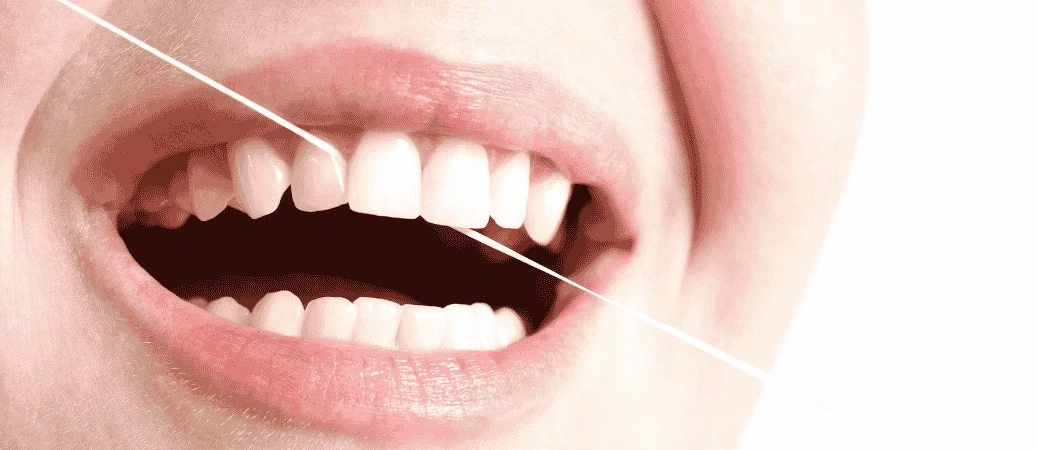
Brush twice a day and floss around the crown daily. The crown itself will not decay, but the natural tooth underneath at the gum line still can, and that margin is where crowns most often fail.
Slide floss out sideways rather than snapping it up past the contact, which protects the edge of the crown.
If you want a refresher on technique, working through how to floss your teeth properly is worth ten minutes.
Teeth grinding is the biggest long-term threat. If you clench at night, ask about a custom night guard, which spreads the force across your teeth instead of loading it onto one ceramic crown.
Skip ice chewing, hard candy, and using your teeth to open packaging. With reasonable care, crowns from same-day crown technology commonly last 10 to 15 years or more.
How Costs, Dental Insurance, and CareCredit May Work
Most dental insurance plans treat a same-day crown the same as any other crown, since the billing code is based on the material and the tooth, not the technology.
Typical coverage sits around 50 percent of the allowed amount after your deductible, subject to your annual maximum.
Two things to check before your visit:
- Waiting period. Many plans require 6 to 12 months of coverage before paying for crowns.
- Frequency limit. Most plans cover replacing a crown on the same tooth only once every 5 to 7 years.
Ask the office for a pre-treatment estimate. They can submit the planned code to your insurer and get a written breakdown of what your plan will pay.
CareCredit and similar health financing cards are widely accepted for the remaining balance, often with interest-free promotional periods of 6 to 18 months.
Many offices also offer in-house payment plans, so ask before you assume financing is your only option.
Premier Dental Associates offers several financing options that may help eligible patients manage dental treatment costs, including CareCredit, LendingPoint, Alphaeon Credit, and Proceed Finance.
You can review the available financing options and application information before your treatment.
Prepared for One Visit, Restored for the Long Term
Same-day CEREC crowns compress a two-week process into one appointment without changing what the finished restoration does for your tooth.
You still get a permanent crown that protects the tooth and takes full chewing force, bonded before you leave.
Preparation is straightforward. Eat first, clear two hours, bring something to occupy the milling wait, and tell the team about anxiety or grinding before treatment starts.
Ask your dentist directly whether your tooth is a good same-day candidate.
A single back tooth with a healthy root fits the workflow well; a front tooth needing detailed shading or a case spanning multiple teeth may do better with lab work.
After the visit, watch your bite for a week and call if anything feels high. That one follow-up call is the difference between a crown that feels like your own tooth and one you notice every time you chew.
Frequently Asked Questions
How long does a same-day CEREC crown appointment take?
Plan on about two hours from check-in to walking out, though straightforward cases can finish in 90 minutes.
The tooth preparation takes 20 to 30 minutes, the scan and design about 15 to 20 minutes, and milling 10 to 20 minutes, with fitting and bonding at the end.
Do I need a temporary crown with CEREC?
No. The permanent crown is milled and bonded during the same appointment, so there is no gap requiring a temporary crown. That removes the risk of a temporary loosening or falling off between visits.
What are the disadvantages of same-day CEREC crowns?
The main trade-offs are a longer single appointment, a narrower range of ceramic materials than a lab offers, and shade matching done chairside rather than by a ceramist.
Front teeth that need layered translucency and multi-tooth cases are often better served by lab-made crowns.
Does tooth preparation hurt during a CEREC appointment?
Tooth preparation should not hurt, because the tooth and surrounding gum are numbed with local anesthetic first.
You will feel pressure, vibration, and water spray, and you can raise your hand at any point if you feel anything sharp.
Can I eat normally after getting a same-day crown?
Yes, once the numbness fully wears off in two to four hours. The crown is bonded and fully functional immediately, though many patients prefer softer foods for the first day while the gum tissue settles.
Are CEREC crowns covered by dental insurance?
Most dental insurance plans cover CEREC crowns at the same rate as traditional crowns, commonly around 50 percent after your deductible.
Check for waiting periods and replacement frequency limits, and ask the office to submit a pre-treatment estimate so you know your cost before the appointment.